



Clear communication is one of those things you only really notice when it goes wrong. In schools, warehouses, offices, retail spaces and public buildings, being able to make a clear announcement at a moment’s notice isn’t just convenient - it’s essential. Whether it’s calling a student to reception, alerting staff to a delivery, announcing a closing time, or issuing an urgent safety message, every word needs to be heard and understood.
Poor communication can quickly lead to confusion, missed instructions and, in some cases, genuine safety risks. A garbled announcement over a crackly speaker doesn’t inspire confidence - and in an emergency, it simply isn’t good enough.
That’s where a properly designed paging sound system comes in. With the right combination of speakers, amplifiers and a reliable paging microphone, you can deliver clear, controlled messages exactly where they’re needed.
In this guide, we’ll break down what a paging system is, how it works, and the components that make it tick - as well as why working with specialists such as Audio Installations helps ensure dependable, crystal-clear performance from day one.
What Is a Paging System?
At its core, a paging sound system is designed to distribute spoken announcements clearly across a building, site or campus. Instead of relying on word of mouth, radios or internal messaging apps, a paging system allows one person to speak into a paging microphone and have their voice heard instantly through multiple paging system speakers positioned throughout the space.
While it might look similar to a standard music playback setup, there’s an important difference. A music system is built primarily for sound quality and entertainment. A paging system, on the other hand, is engineered for speech intelligibility. That means clarity comes first - every word needs to be understood, even in noisy environments like warehouses, playgrounds or busy retail floors.
Most paging systems are one-way communication tools. A member of staff speaks into a paging mic, and the announcement is broadcast outwards. This differs from two-way systems such as intercoms or radios, where conversation flows in both directions.
Paging can be manual - where someone physically makes an announcement - or automated. Many systems can be set up to play pre-recorded messages, such as scheduled bell tones in schools or safety reminders in industrial settings.
You’ll also come across zoned and non-zoned systems. A non-zoned system broadcasts to every paging system speaker at once. Zoned systems allow you to target specific areas, such as “Warehouse Only” or “Reception and Offices”, offering far more control.
In many buildings, paging forms part of a wider PA or even a voice evacuation system, adding an extra layer of safety and organisation.
What Does a Paging System Do?
A paging system is all about getting the right message to the right people, at the right time - and doing it clearly. The most common function is live voice announcements: a member of staff speaks into a microphone and the message is broadcast through the building’s speakers. In busy environments, that instant reach can save time, reduce confusion, and keep everyone aligned.
Many systems also support pre-recorded message playback. This is handy for routine reminders (“Please report to reception”), scheduled messages, or consistent safety prompts in workplaces where you want the wording to stay the same every time.
Where paging really becomes useful is with zoned communication. Instead of broadcasting to everyone, you can target specific areas - for example, paging just the warehouse, only the shop floor, or only the offices. That means fewer interruptions, more control, and better day-to-day flow.
Paging systems can also be configured for emergency broadcasting, ensuring critical instructions cut through background noise and reach multiple areas quickly. In schools, they’re often paired with bell schedules and tone playback for lesson changes. In warehouses, they support staff coordination across large, noisy spaces. In retail, they’re used for customer announcements, queue management, and team communication.
Whatever the setting, the goal is the same: clarity, coverage, reliability, and control. And that’s exactly why a properly designed system matters - speaker choice, placement, zoning, and the right amplification all make the difference between “message received” and “what did they say?”
Where Are Paging Systems Used?
Schools and Colleges
Education settings are one of the most common environments for a paging system. From daily announcements and class change bells to lockdown procedures, clear communication is essential. Messages need to be heard in classrooms, corridors, reception areas and often outside on playgrounds too.
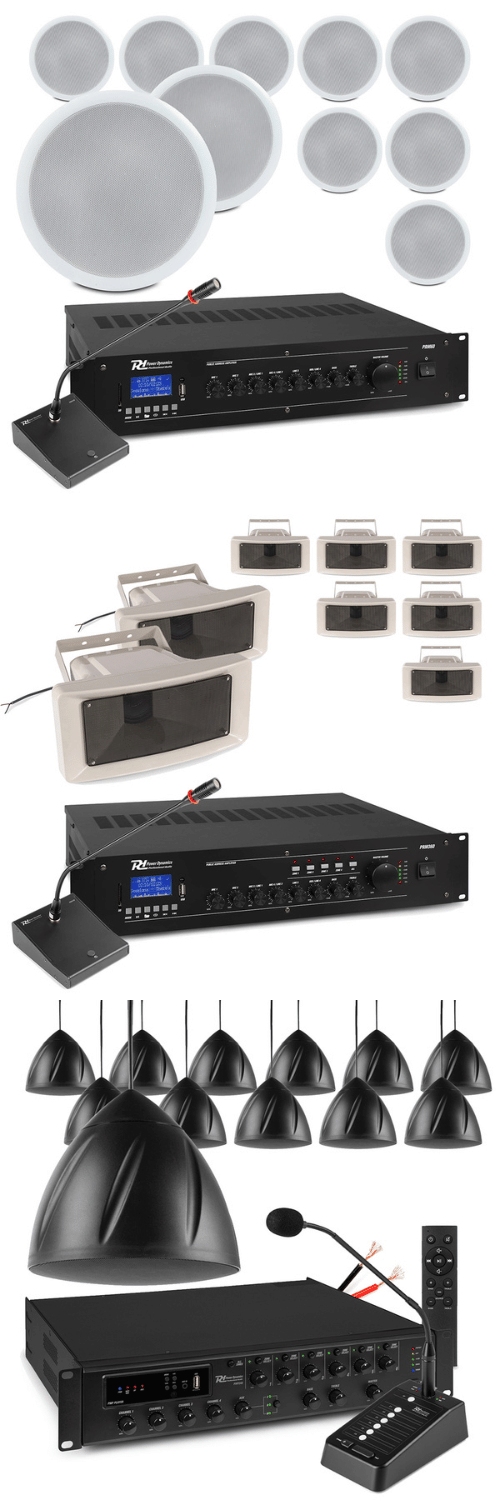
A well-designed School PA system with ceiling speakers and paging microphone - such as an 18x CSPB5 ceiling speaker system - is ideal for indoor coverage. Ceiling speakers are discreet, evenly spaced, and designed to distribute speech clearly without being visually intrusive. They blend neatly into classroom ceilings while delivering consistent coverage across multiple rooms.
For schools with outdoor spaces, additional speakers can extend announcements to playgrounds and sports areas, ensuring no one misses important information.
Colleges and Outdoor Campuses
Larger college sites often need announcements to carry between buildings, across courtyards, or onto sports fields. In these situations, weather-resistant equipment becomes essential.
An outdoor sound system for colleges using 8x HS30MS horn speakers, paired with a mixer amplifier and paging mic, is designed specifically for this challenge. Horn speakers are commonly used outdoors because they offer directional projection, pushing sound further and focusing it where it’s needed. They’re also highly efficient, meaning they produce strong output with minimal power, and they’re built to withstand the elements.
This combination ensures announcements remain clear, even in open air and over longer distances.
Retail & Commercial Spaces
In retail and commercial settings, paging systems often handle a mix of background music and announcements. Staff might page colleagues to the till, call for assistance in specific departments, or make customer service announcements.
Zoned paging is particularly useful here, allowing messages to be directed to stockrooms or staff-only areas without interrupting the entire shop floor.
Warehouses & Industrial Buildings
Warehouses and industrial spaces present different challenges: high ceilings, open-plan layouts, and significant background noise. Standard ceiling speakers aren’t always suitable in these environments.
This is where a system such as the 12x PD PDS40B 30W Pendant Speaker System with 6-zone paging mic comes into its own. Pendant speakers are suspended from high ceilings, positioning the sound closer to ear level. This improves clarity and reduces echo in large, open areas.
Combined with a 6-zone paging microphone, managers can target specific sections of the warehouse, improving coordination without disrupting the entire operation.

What Are the Core Elements of a Paging System?
A reliable paging setup isn’t just a microphone and a few speakers thrown together. It’s a carefully matched system where each component plays a specific role. Let’s break down the essentials.
1. Paging Microphone
The paging microphone is the control point of the entire system. It’s what staff use to make live announcements, typically featuring a push-to-talk button so audio is only broadcast when needed. This prevents background noise and keeps communication intentional and clear.
Paging mics are usually desk-based, often with a flexible gooseneck design that allows easy positioning. Some systems use dynamic microphones, but condenser models are popular for paging because they offer greater sensitivity and speech clarity.
A good example is the PD PMPM10 6-Zone Condenser Paging Microphone. This type of 6-zone paging mic allows the user to select exactly which areas receive the announcement. Instead of broadcasting site-wide, you can page Zone 1 (Reception), Zone 3 (Warehouse), or all zones together. For growing businesses or multi-room buildings, that flexibility is invaluable.
2. Amplifier / Mixer Amplifier
If the microphone is the voice of the system, the amplifier is its engine. The amplifier powers the speakers and ensures the signal reaches them at the correct level.
Many installations use a mixer amplifier, which combines multiple audio inputs - such as a paging mic, background music source, or pre-recorded message player - into one streamlined unit.
Most paging systems operate on a 100V line system. Without getting too technical, a 100V line setup allows multiple speakers to be connected over long cable runs without loss of performance. It’s efficient, scalable, and makes adding extra speakers straightforward - which is why it’s the industry standard for commercial paging installations.
3. Paging System Speakers
The paging system speaker you choose depends entirely on the environment.
- Ceiling speakers – Ideal for offices, classrooms and retail spaces where discreet, even coverage is needed.
- Wall-mounted speakers – Suitable for corridors, smaller rooms or surface-mount installations.
- Pendant speakers – Designed for high ceilings and open-plan areas, bringing sound closer to listeners.
- Horn speakers – Built for outdoor use, offering directional projection and weather resistance.
Speaker choice depends on ceiling height, indoor or outdoor use, background noise levels, and the overall coverage area required. Matching the right speaker type to the space is crucial for clear, intelligible announcements.
4. Zoning & Control
Zoning allows a building to be divided into separate audio areas. A 6-zone system, for example, splits the site into six independently selectable sections. This means you can page a single department without interrupting everyone else.
Zoning improves day-to-day efficiency and provides flexibility for expansion. As a site grows, additional zones and speakers can often be integrated into the existing infrastructure - provided the system has been designed correctly from the outset.
How Does a Paging System Work?
A paging system is quite straightforward once you see it as a simple chain: microphone → amplifier → speakers. Here’s what happens, step by step.
- The user presses the button on the paging mic (push-to-talk). This activates the system and ensures only intentional announcements are broadcast.
- The voice signal is sent to the mixer amplifier. This is the control centre that receives the microphone audio (and often other sources like music or message players).
- The amplifier processes and boosts the signal. It raises the audio to the correct power level so it can drive multiple speakers clearly and consistently.
- The signal is distributed through a 100V line. Instead of sending high current (which loses power quickly over distance), a 100V system sends audio at higher voltage and lower current. That means far less signal loss over long cable runs.
- The selected speakers broadcast the message. If the system is zoned, only the chosen areas will play the announcement. If not, it will go to every speaker connected.
The reason 100V line systems are so common for paging is that they’re reliable and scalable. You can run cable over large buildings or outdoor sites without the audio fading, and you can add more speakers later by tapping into the same line (as long as the amplifier power is sized correctly). That makes them ideal for schools, warehouses, retail units and multi-zone premises where coverage and future flexibility really matter.
Choosing the Right Paging System
Selecting the right paging system isn’t about picking the loudest speakers or the most expensive microphone - it’s about matching the system to the space.
Start with the size of the building. A small office will have very different requirements to a multi-building college campus. Then consider ceiling height. Standard ceiling speakers work well in classrooms and offices, but high ceilings in warehouses often call for pendant or suspended speakers to bring sound closer to ear level.
Indoor versus outdoor use is another key factor. Outdoor areas require weather-resistant equipment, often with horn speakers for longer throw and focused projection. Background noise levels also matter - industrial settings need systems designed specifically for speech intelligibility in challenging environments.
You’ll also want to think about zoning requirements. Do you need to page individual areas separately? And what about future expansion? Choosing a scalable 100V line system with spare capacity can save significant time and cost later on.
While smaller setups can be installed by competent DIYers, larger or multi-zone systems benefit from professional design. Correct speaker placement, amplifier sizing and cable planning all affect clarity and reliability.
This is where working with specialists makes sense. Audio Installations provides complete system packages, pre-configured solutions and expert advice tailored to schools, colleges, retail spaces and commercial sites. Whether it’s a straightforward school PA system or a more complex multi-zone setup, having a properly specified system from the outset ensures your paging remains clear, controlled and dependable for years to come.
Why Professional Design Matters
A paging system might seem straightforward on paper, but small design mistakes can have a big impact. Incorrect speaker placement often creates dead spots where announcements are faint or unintelligible. In larger rooms, poor positioning can also lead to echo and reflections that reduce speech clarity.
An underpowered amplifier is another common issue. If the system doesn’t have enough headroom, announcements can distort when volume is increased - exactly when clarity matters most. On the other hand, poor zoning decisions can limit flexibility, making it difficult to target specific areas as your site evolves.
Outdoor systems add another layer of complexity. Equipment must be properly weather-rated, and speaker selection needs to account for projection distance and ambient noise. Cable runs also need accurate calculation, particularly in 100V line systems, to ensure consistent performance and safe operation.
Audio Installations specialises in commercial and educational audio solutions, with experience in paging sound system design across schools, colleges and business premises. By tailoring systems to the specific requirements of each site, they help ensure announcements are clear, reliable and fit for purpose from day one.
Conclusion
A paging sound system is, at its heart, a practical communication tool. It allows a single voice to be distributed clearly across multiple areas using a combination of a paging microphone, amplifier and carefully selected speakers. Whether that’s a ceiling-mounted paging system speaker in a classroom, a pendant speaker in a warehouse, or a weatherproof horn covering an outdoor courtyard, each component plays a defined role.
We’ve looked at how a paging mic connects through a mixer amplifier, how 100V line systems allow reliable signal distribution over long distances, and why zoning provides valuable control. From schools managing lesson changes and safety procedures, to colleges coordinating across outdoor campuses, and commercial sites handling staff and customer announcements, the applications are wide-ranging.
The common thread is clarity and reliability. The right paging microphone, correctly powered speakers, and a properly specified system layout make the difference between muddled messages and confident communication.
For schools, colleges, commercial buildings or outdoor spaces, Audio Installations can design and supply a reliable paging sound system tailored to your environment - ensuring every announcement is heard exactly as intended.
